Blog
UV DTF Decals for Boat Registration Numbers: How to Choose

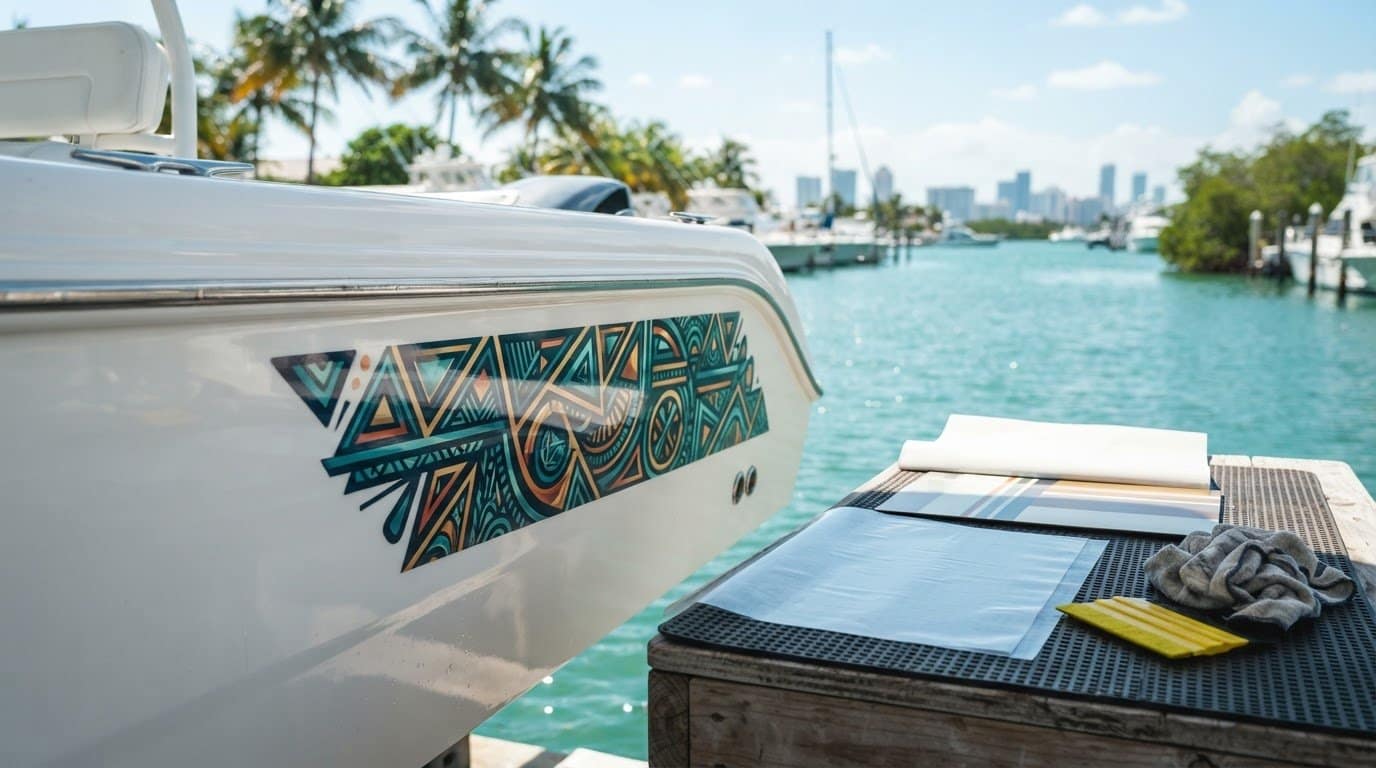
The easiest decal to apply may not be the right choice for your boat. UV DTF decals for boat registration numbers can reproduce detailed artwork on compatible hard surfaces, but ease of application does not establish that a decal meets registration rules or will hold up to sun, water, and saltwater exposure.
Before choosing a material, separate the required registration format from optional design choices. Check current Florida Fish and Wildlife Conservation Commission guidance, then assess the hull surface and the decal’s specifications for the conditions it will face. Do not assume a product is rated for marine use without supporting information.
This guide explains how UV DTF decals work and compares them with marine vinyl and painted lettering. You will learn what to check about the hull surface, placement, artwork, and application before ordering custom numbers. Captain Printing produces UV DTF decals for hard surfaces at 13680 NW 19th Ave Unit 1B in Opa-locka, near Miami.
Key Takeaways
- UV DTF decals for boat registration numbers are a hard-surface option, not proof of marine suitability or registration compliance.
- Compare UV DTF, marine vinyl, and painted lettering by design needs, surface compatibility, and application method.
- Follow the supplied transfer instructions for surface preparation and application. Check the hull finish and intended exposure first.
- Before ordering, verify current registration requirements and prepare the approved layout, dimensions, artwork, and placement details.
- Captain Printing produces custom UV DTF decals at its Opa-locka shop near Miami.
Are UV DTF Decals a Practical Option for Boat Registration Numbers?
UV DTF can be an option for boat numbers when the intended hull area is compatible with the decal, but the method alone does not establish marine suitability. Make three separate decisions: confirm the required number layout, assess the application surface, and select a print method that fits the boat’s use.
Sun, water, and saltwater exposure make unsupported durability assumptions risky. Without product specifications for those conditions, do not treat a UV DTF decal as guaranteed to last or adhere on a boat. Registration compliance is a separate question. Check current Florida Fish and Wildlife Conservation Commission guidance for the requirements that apply to your vessel before preparing the final artwork.
- Number layout: Verify current registration guidance before designing or ordering.
- Surface: Identify the exact application area and assess whether it is smooth, clean, stable, and compatible.
- Print method: Match the decal or lettering approach to the artwork, hull finish, and exposure conditions.
What does UV DTF mean for a boat decal?
A UV DTF decal is a printed graphic transferred with adhesive to a compatible hard surface. It is not a heat-applied apparel transfer, which is made for application to fabric using heat and pressure. The general decal concept is a graphic transferred onto another surface, but that definition does not establish how a particular product will perform on a boat.
UV DTF is intended for hard-surface applications. A hull’s material, finish, condition, and exposure all matter, so the word “decal” should not be taken as proof of compatibility, marine rating, lifespan, or guaranteed adhesion.
What should boat owners decide before choosing a decal?
Start with the exact area where the numbers will go. Note the surface material, finish, curvature, and condition, and determine whether it can be properly cleaned and prepared. A smooth, clean area may be a useful starting point, but it does not confirm that a particular decal will adhere reliably.
Next, account for the boat’s expected exposure to sun, water, and saltwater. Select a method only with realistic expectations about the specifications available for that use. Keep design decisions separate from compliance: check Florida registration guidance before settling the layout, then prepare the artwork accordingly. For custom printed options in the Miami area, explore custom stickers in Miami.
How Do UV DTF Boat Decals Apply to a Hull Surface?
Apply UV DTF decals only to a compatible surface, and follow the instructions supplied with the transfer for preparation, positioning, pressure, and carrier removal. A clean, dry surface helps avoid trapping dirt or moisture beneath the decal, but it does not prove that the hull finish is suitable or that the decal is rated for marine exposure.
For uv dtf decals for boat registration numbers, treat installation as a careful transfer process, not a shortcut around checking surface compatibility. Do not add cleaners, solvents, temperature settings, or curing steps unless the product instructions specify them.
How should you prepare a boat surface?
Identify the exact application area before preparing it. The finish should be stable and free of dirt, residue, and moisture. Avoid applying over peeling, rough, or unstable coatings, since an uneven or failing surface can interfere with the result.
Use only the cleaning and preparation method specified in the transfer instructions. Boat finishes vary, so do not assume a particular solvent or cleaner is appropriate. If the hull surface is damaged, textured, or difficult to assess, resolve that concern before applying the decal.
What application details affect the result?
Use this cautious workflow, then follow the product-specific directions for each step:
- Review the instructions. Read the supplied directions before removing the transfer from its carrier.
- Prepare the area. Clean and dry the intended spot using the specified method. Check that the finish is stable.
- Plan the position. Align the decal before application. Confirm the number layout and placement separately against current registration guidance.
- Apply as directed. Follow the transfer instructions for pressure and carrier removal. Do not substitute a heat press or invent a temperature setting.
- Inspect the result. Follow any stated post-application directions. For an unfamiliar finish, a test application on a comparable surface may help assess the process before applying the full design.
Captain Printing provides UV DTF decals for hard surfaces. Follow the application instructions supplied with your transfer. If your project is for fabric rather than a boat hull, see DTF transfers in Miami, which use a different application method.
UV DTF vs. Marine Vinyl vs. Painted Boat Numbers
Choose a method based on the required number layout, the boat’s finish, the artwork, and the conditions the lettering will face. No method is automatically suitable for every hull. Marine exposure depends on verified material specifications and surface conditions, so appearance alone cannot establish resistance to sun, water, or saltwater.
| Method | Surface compatibility | Application approach | Customization and checks |
|---|---|---|---|
| UV DTF | Compatible hard surfaces | Adhesive transfer applied to the prepared surface | Can reproduce custom printed artwork. Verify surface fit and product specifications for intended exposure. |
| Marine vinyl | Boat finishes compatible with the specific vinyl | Cut or printed film adhered to the hull | Useful for lettering and graphics. Check the material specifications and application guidance. |
| Painted lettering | Surfaces suitable for the selected paint system | Paint applied directly to the vessel surface | Can be applied as lettering or a design. Check surface preparation, paint compatibility, and registration requirements. |
When might a printed decal make sense?
UV DTF may suit a compatible hard surface when the design includes custom artwork or more than plain lettering. Its transfer-style application differs from painting directly on the hull and from applying cut or printed vinyl film. That convenience does not prove that a particular decal is appropriate for continuous marine exposure.
For custom printed options in the Miami area, browse custom stickers in Miami. Review the product specifications and application instructions for the actual surface and intended use before selecting a decal for a boat.
How do vinyl and painted lettering differ?
Marine vinyl is a film applied to the hull, either cut into lettering or printed with a design. Painted lettering is applied directly to the vessel. Installation, maintenance, and replacement depend on the material, the boat’s finish, and the preparation process. Film removal may affect the surface or leave residue. Repainting can involve preparing and refinishing the area.
Before choosing, compare each method with the hull finish and expected exposure. Check current Florida registration guidance separately, since a material choice does not determine whether the number layout complies. For a separate crew-apparel project, see DTF transfers in Miami, which are intended for fabric rather than boat hulls.
What Should You Check Before Ordering Boat Registration Decals?
Before ordering uv dtf decals for boat registration numbers, verify the official marking requirements, prepare the exact character layout, and identify the intended hull surface. These checks separate registration decisions from decal design and production. Do not assume that a sample design or a particular print method makes the finished numbers compliant.
Which Florida registration details need verification?
Check current boat-marking guidance from the Florida Fish and Wildlife Conservation Commission (FWC) before finalizing artwork. Confirm the requirements that apply to your vessel, including number format, dimensions, placement, color, and spacing. Requirements can change, so rely on current official guidance rather than an old decal, online example, or general design template.
Keep those rules separate from printing. A print shop can produce the supplied artwork, but a decal’s appearance does not establish that its layout meets state requirements.
What artwork and order details should you prepare?
Once you have checked the official guidance, prepare the exact registration characters and a clear layout. Review every letter and number, then specify the desired dimensions and color based on the verified requirements. Identify the boat’s finish and precise application area so the decal size and format can be planned for that surface.
Use this pre-order checklist:
- Registration: Verify current requirements with the FWC.
- Artwork: Provide the exact characters and a legible layout.
- Dimensions: Set the size from official guidance and the intended application area.
- Surface: Note the hull material, finish, condition, and location for the decal.
- Exposure: Consider expected sun, water, and saltwater contact. Do not assume performance without relevant product specifications.
These details help distinguish a design that can be printed from one that is suitable for the chosen application. A smooth appearance in a proof does not confirm surface compatibility or marine durability.
Captain Printing produces custom printed products at 13680 NW 19th Ave Unit 1B in Opa-locka, near Miami. For a separate apparel project, order DTF transfers in Miami.
Order Custom UV DTF Decals in Miami for Your Boat
Captain Printing produces UV DTF transfers and decals for hard surfaces at its Opa-locka shop near Miami. The location serves customers looking for custom printed products in the Miami area.
Before placing an order, prepare the approved registration layout and details about the intended application area. Keep the artwork, hull-surface assessment, and registration check as separate steps. This makes it easier to review what the print should reproduce without treating the print method as proof of compliance or marine durability.
Why order custom decals from a Miami-area print shop?
A local shop gives boat owners a place to discuss a project and bring clear details about the hull surface and intended application area. Captain Printing produces UV DTF decals in Opa-locka for compatible hard surfaces. For boat owners comparing uv dtf decals for boat registration numbers, keep the production discussion focused on the approved artwork and surface details. Verify registration requirements separately with the Florida Fish and Wildlife Conservation Commission.
How can you move from artwork to a finished decal?
Prepare the final characters and layout after checking current registration guidance. Provide the intended application area and surface information so the order reflects the actual project. Review the artwork before production, then follow the decal’s supplied instructions when applying it. These steps keep registration decisions, production, and surface preparation distinct.
For more background on UV DTF and hard-surface decals, read “UV DTF Transfers: The Ultimate Guide to Permanent Hard Surface Decals.” Captain Printing also produces DTF transfers for fabric applications. For apparel graphics, order DTF transfers in Miami.
Choose Your Boat Numbering Method With Confidence
UV DTF decals for boat registration numbers may suit a compatible hard surface, but the method alone does not prove marine durability or registration compliance. Check current Florida Fish and Wildlife Conservation Commission guidance, assess the hull finish, and compare UV DTF with marine vinyl or painted lettering before ordering.
Captain Printing produces custom printed products in Opa-locka, near Miami. To plan a UV DTF decal, have your approved artwork and information about the intended surface ready. For apparel graphics, start your DTF transfer order.
Frequently Asked Questions
Are UV DTF decals suitable for boat registration numbers?
They may be suitable if the decal is compatible with the hull surface and intended exposure, but the UV DTF method alone does not establish marine suitability or registration compliance. UV DTF decals are adhesive transfers for compatible hard surfaces, not heat-applied apparel transfers. Verify the required number layout with Florida’s Fish and Wildlife Conservation Commission, then assess the hull finish and product specifications for the planned use.
Will UV DTF decals stay on a boat in saltwater?
There is no basis to guarantee that a UV DTF decal will stay attached in saltwater without product specifications supporting that use. Performance can depend on the decal, surface condition, preparation, and exposure. Check documentation for the specific product and follow its application instructions. Do not treat a smooth appearance or successful application on another object as proof that the decal will withstand repeated saltwater exposure on your boat.
Can UV DTF decals be applied directly to a fiberglass boat hull?
Possibly, if the particular fiberglass finish is compatible with the decal and the application instructions. Fiberglass hulls may have different finishes and conditions, so the material name alone does not confirm adhesion. Identify the exact application area and check that the finish is smooth, clean, dry, and stable. Follow the supplied preparation directions, and avoid applying over peeling, rough, or damaged coatings.
What Florida requirements apply to boat registration numbers?
Check current vessel-marking requirements with the Florida Fish and Wildlife Conservation Commission (FWC), the official source for Florida guidance. Verify the requirements that apply to your boat, including number format, dimensions, placement, color, and spacing, before finalizing artwork. Do not rely on an old decal, sample design, or printer proof as evidence of compliance. The printing method and registration rules are separate decisions.
How do you apply UV DTF decals to a boat?
Follow the instructions supplied with the specific transfer. Identify a compatible, stable surface, prepare it using the instructed method, and make sure it is clean and dry. Position the decal carefully, apply the specified pressure, and remove the carrier as directed. Do not substitute cleaners, solvents, heat, or curing steps unless the instructions call for them. On an unfamiliar finish, consider testing on a comparable surface first.
Are UV DTF decals better than marine vinyl for boat numbers?
Neither method is universally better. UV DTF transfers can suit custom printed artwork on compatible hard surfaces, while marine vinyl uses cut or printed film applied to the hull. Compare the methods by artwork, application process, surface compatibility, and available exposure specifications. For simple lettering, vinyl may fit the design needs. For either option, confirm the material guidance and current registration requirements before installation.
For custom UV DTF decals near Miami, bring your approved artwork and hull-surface details to Captain Printing at 13680 NW 19th Ave Unit 1B in Opa-locka, or call to discuss your project.
Phone: +1 (305) 930-4700 | Address: 13680 NW 19th Ave, Unit 1B, Opa-locka, FL 33054 | Email: [email protected]